
HDF Compared With MDF: Which Is Better For Cabinets In Canada?
HDF compared with MDF which is actually better for cabinet material selection is key in Canada. A new Kitchen Cabinet is a major decision. Rtadepot.ca provides durable, stylish engineered wood RTA kitchen cabinetry. This decision forms the foundation of your kitchen’s longevity, beauty, and function. It can turn a cluttered, outdated space into the organized, modern heart of your home.
Choosing the right Kitchen Cabinet material is the first step to solving your storage frustrations. This choice helps you achieve the high-end look you desire for your Canadian home.
1. The Modern Homeowner’s Dilemma: Why Your Cabinet Choice Matters
Choosing a new Kitchen Cabinet is one of the most significant investments you will make in your home. It is not merely a purchase; it is a long-term decision. This Kitchen Cabinet choice directly impacts your daily life, your home’s financial value, and your personal comfort. Many homeowners begin this journey feeling frustrated with their current situation.
Perhaps your existing kitchen cupboards are a daily reminder of a bygone era, with warped doors, peeling laminate, and a style that no longer reflects your own. You might be struggling with a profound lack of efficient storage. This leads to a cascade of small, daily frustrations: cluttered countertops, a pantry where items get lost, and a constant, low-level stress from disorganized spaces. This is especially true in urban Canadian homes and condos where maximizing every square inch is not a luxury, but a necessity for your new Kitchen Cabinet layout.
Your kitchen’s workflow might be compromised by a poor layout, making cooking feel more like a chore than a creative pleasure. You have a vision for a better, more streamlined life. You are seeking a space that is not only beautiful but also intelligently organized, a space that serves your family and allows you to entertain with pride, and the right Kitchen Cabinet is central to that.
1.1. The Search for the Perfect Solution
This is where the search for new kitchen units begins, and with it, a new set of challenges. You need a solution that balances four critical elements for your Kitchen Cabinet project.
- ✓Aesthetics: You want a premium, modern look that elevates your entire home.
- ✓Durability: This is a long-term investment. Your Kitchen Cabinet must withstand the rigors of daily use.
- ✓Functionality: The solution must optimize your space and improve your home’s efficiency.
- ✓Cost: You want high-end quality without the astronomical price tag of fully bespoke, custom-built carpentry. This is why many avoid options that are not budget-friendly, unlike a simple ikea cabinet.
In this search, you will quickly discover that the market is dominated by two leading materials: MDF (Medium-Density Fiberboard) and HDF (High-Density Fiberboard). As engineered wood products, they were designed to solve the primary problems of solid wood, such as a tendency to warp, crack with humidity changes, and high cost.
But deciding between them is confusing. Is HDF or MDF better for a Kitchen Cabinet? Is the more expensive option truly worth it? Understanding the fundamental differences in their properties, performance, and cost is the only way to make a confident decision. This guide will provide that clarity for your next Kitchen Cabinet purchase.
2. What Exactly is Medium-Density Fiberboard (MDF)?
MDF is a popular, budget-friendly engineered wood composite, prized for its exceptionally smooth surface, making it ideal for painted kitchen cabinets. For a standard 10’x10′ kitchen, MDF cabinets can often be 15-20% less expensive than HDF. However, its primary weakness is a high susceptibility to moisture damage if its seal is broken.
Medium-Density Fiberboard, or MDF, is perhaps the most ubiquitous and versatile engineered wood product in the Kitchen Cabinet industry. It has become a standard for its reliability, smooth finish, and excellent value. It provides a high-quality alternative to solid wood and particleboard.
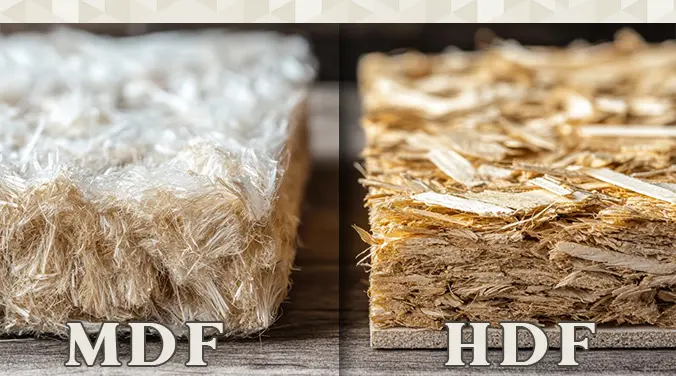
To understand MDF, you must first understand its construction. MDF is manufactured by breaking down hardwood or softwood residuals (like sawdust and wood chips) into very fine, consistent wood fibers. These fibers are then combined with a wax and a strong resin binder. This mixture is spread into a mat and subjected to significant heat and pressure.
The “Medium-Density” name is key, with a typical density ranging from 600 to 800 kg/m³ (about 38-50 lbs/ft³). This process results in a panel that is dense, stable, and perfectly uniform. It has no knots, grain patterns, or voids. This consistency is its greatest strength for any Kitchen Cabinet door.
2.1. Pros: The Case for MDF Cabinets
MDF is popular for many compelling reasons, making it an excellent choice for a wide range of kitchen cabinetry applications.
- ✓Unmatched Surface Smoothness: Because MDF is made from fine, compressed fibers, its surface is exceptionally smooth and non-porous. This is its most significant advantage. It is the perfect canvas for paint, as it results in a flawless, even finish that solid wood, with its inherent grain, can never achieve on a Kitchen Cabinet front.
- ✓Design Versatility and Machinability: The uniform structure of MDF means it can be cut, drilled, and machined with high precision without splintering. This allows manufacturers to create a vast array of Kitchen Cabinet door styles, from complex, routered raised panels to the clean, sharp lines of a modern Shaker or slab door.
- ✓Cost-Effectiveness and High Value: Addressing the cost difference between HDF and MDF for a Kitchen Cabinet, MDF is the clear winner in terms of budget-friendliness. It provides a high-end look for a fraction of the cost of solid wood or HDF. This allows you to allocate more of your renovation budget to other elements.
- ✓Stability Over Solid Wood: Unlike solid wood, MDF is an isotropic material. It does not have a grain that will expand and contract with changes in temperature and humidity. This makes it far less likely to warp, crack, or bow, which is a common issue with solid wood, especially on a painted Kitchen Cabinet door.
2.2. What Are the Real-World Limitations of MDF Cabinets?
The most critical limitation is moisture. A single undetected leak from a dishwasher, for example, can cause an MDF panel to swell by up to 40% of its original thickness. It is also heavier and less impact-resistant than HDF, making it more prone to dents and sagging hinges over decades of heavy use.
While MDF is an excellent material, it is essential to understand its weaknesses, especially in a high-use area like a kitchen or bathroom.
- ✓Moisture Susceptibility: This is the primary and most significant drawback of MDF. If the outer sealed layer (paint, thermofoil, or veneer) is compromised—for instance, by a deep scratch—MDF will act like a sponge when it comes into contact with water. The fibers will absorb the moisture, swell, and deform. This damage is typically irreversible and can ruin a Kitchen Cabinet.
- ✓Heavy Weight: MDF is a dense and heavy material. While this adds to its sturdy feel, it also puts significant stress on wall mountings and hardware. It requires robust Kitchen Cabinet boxes and high-quality hinges to prevent sagging over time.
- ✓Lower Impact Resistance: The “medium” density means it is softer than HDF. It can be dented or scratched more easily with a sharp impact.
- ✓Screw-Holding Capacity: While generally good, MDF’s grip on screws is not as tenacious as HDF. If a screw is over-tightened, it can “strip” the fibers, making it difficult for the screw to get a good grip again. This can be an issue for Kitchen Cabinet hinges after many years.
3. Why is High-Density Fiberboard (HDF) Considered a Premium Option?
HDF is a premium material due to its extreme density, typically over 800 kg/m³ (50 lbs/ft³), which provides superior durability, impact resistance, and moisture resistance compared to MDF. Its hard, flawless surface is considered the gold standard for a luxurious, long-lasting painted cabinet finish.
If MDF is the versatile workhorse, High-Density Fiberboard (HDF) is the high-performance, premium contender. It is visibly similar to MDF but is a fundamentally different product in terms of its physical properties. This makes it a preferred choice for a high-end Kitchen Cabinet and other demanding applications.
HDF is made using a process similar to MDF, but with critical differences. It also uses fine wood fibers, wax, and a resin binder. However, this mixture is compressed under extreme heat and pressure—significantly more than what is used for MDF. This process, while consuming more energy and increasing cost, creates a board that is exceptionally hard and dense.
This intense compression results in a board that is exceptionally hard and incredibly dense. HDF’s density typically starts where MDF’s ends, ranging from 800 to 1040 kg/m³ (about 50-65 lbs/ft³). This creates a board that is stronger, harder, and much more resistant for your Kitchen Cabinet.
3.1. Pros: The Compelling Advantages of HDF for Cabinets
For Canadian homeowners seeking the best in durability and a flawless finish, HDF presents a clear case for its use, especially for Kitchen Cabinet doors and drawer fronts.
- ✓Superior Durability and Impact Resistance: This is a key factor in the HDF vs MDF durability debate. HDF is substantially harder than MDF. It is highly resistant to dings, dents, and scratches. In a busy family kitchen, HDF provides a level of resilience that MDF cannot match for your Kitchen Cabinet.
- ✓Enhanced Moisture Resistance: While not fully waterproof, HDF’s extreme density makes it significantly more resistant to moisture penetration. Water takes much longer to seep into the core, giving you more time to clean up spills. This makes it a much safer choice for a Kitchen Cabinet near a sink or dishwasher.
- ✓The Ultimate Surface for a Flawless Painted Finish: HDF’s hard, non-porous, and perfectly smooth surface is the gold standard for a painted finish. It accepts paint beautifully, resulting in a glass-like, durable, and luxurious finish. It is the perfect base for custom colours, even more so than standard nieu cabinet doors.
- ✓Exceptional Structural Strength and Screw Hold: HDF is incredibly strong and rigid. Its dense core grips screws with exceptional force. This means hinges will not loosen, and a Kitchen Cabinet door will not sag over time, even with heavy use.
3.2. Cons: Considerations and Trade-Offs for HDF
The premium performance of HDF comes with a few trade-offs that are important to consider for your Kitchen Cabinet project.
- ✓The Cost Factor: The primary consideration is cost. The more intensive manufacturing process makes HDF a more expensive material than MDF. This is the main reason for the cost difference when comparing Kitchen Cabinet materials.
- ✓Extreme Weight: HDF is even heavier than MDF. This substantial weight adds to its premium feel but also reinforces the need for high-quality, heavy-duty hinges and robust Kitchen Cabinet boxes to support it.
- ✓Common Applications: Because of its weight and cost, HDF is less commonly used for the entire Kitchen Cabinet box. It is most often used for the parts that take the most abuse: the cabinet doors and drawer fronts. These are often paired with a high-quality plywood cabinet box.
4. HDF Compared With MDF: The Head-to-Head Battle
Now that we have explored the pros and cons of HDF and MDF individually, let us put them side-by-side. This will answer the central question: which is actually better for your Kitchen Cabinet upgrades in Canada?
4.1. Direct Properties Comparison
This table summarizes the essential differences that will impact your cabinet’s performance.
4.2. The Big Three: Durability, Moisture, and Longevity
When homeowners ask about HDF vs MDF durability in cabinets, they are usually asking about these three things:
- 1Impact (Durability): Imagine you drop a heavy cast-iron skillet against a Kitchen Cabinet door. An MDF door is likely to dent. An HDF door, due to its superior hardness, is much more likely to withstand the impact with no visible damage. For a busy family, this long-term resilience is a major advantage.
- 2Moisture (Resilience): Consider a slow, undetected leak under your sink. With an MDF cabinet box, the wicking action of the fibers could cause catastrophic swelling and disintegration within a short time. HDF’s dense composition will resist water penetration for much longer, potentially saving you from a costly Kitchen Cabinet replacement.
- 3Use (Longevity): Think about the kitchen’s most-used cabinet door—perhaps the one for glasses. After five years and thousands of openings, the screws on an MDF door’s hinge might begin to loosen, causing the door to sag. The superior screw-holding power of HDF means the hinge will remain tight and the Kitchen Cabinet door perfectly aligned.
4.3. The Cost vs. Value Equation
Your budget is a primary driver. The cost difference between HDF and MDF for a Kitchen Cabinet is not trivial. Many Canadians are balancing renovation costs with everything else, right down to the price of groceries like cheap rice.
MDF is the “High-Value” Choice: It allows you to achieve a beautiful, modern, and functional kitchen for a lower upfront investment. If you are renovating to sell in 5-7 years, or if you are careful in your kitchen, MDF provides exceptional value for your Kitchen Cabinet.
HDF is the “High-Investment” Choice: You are paying a premium for long-term performance. If this is your “forever home” and you are investing in a kitchen that will last 15-25 years, the extra cost of HDF can be justified as an investment in durability and peace of mind.
4.4. The Expert’s Secret: Using Both
Here is a critical piece of information that many homeowners overlook: the best material for kitchen cabinetry is not always an either/or choice. The most intelligent cabinet design often uses a combination of materials, leveraging the strengths of each.
For Cabinet Doors and Drawer Fronts: HDF is the superior choice for painted finishes due to its smooth surface and durability. MDF is an excellent second choice.
For Cabinet Boxes (Carcasses): Neither HDF nor MDF is the truly superior choice. HDF is too heavy and expensive. MDF is functional but susceptible to moisture. This is why many high-quality, RTA (Ready-to-Assemble) cabinet lines, including those offered by rtadepot.ca, use furniture-grade plywood for the cabinet boxes. Plywood is lighter, has excellent structural stability, and holds screws well.
A premium premade cabinet configuration might feature durable plywood boxes, robust HDF doors for the painted finish, and MDF for specific decorative elements like crown molding, which is easily machined. This is a common setup for a quality rti cabinet system.
5. Beyond the Boards: Health, Safety, and Your Home Environment
When investing in your home (a significant YMYL or Your Money Your Life decision), the material’s performance is only part of the story. The health and safety of your family are paramount. Both MDF and HDF are manufactured using resins, which historically contained urea-formaldehyde (UF).
Formaldehyde is a volatile organic compound (VOC) that can “off-gas” into your home, potentially causing respiratory irritation and other health concerns. Reputable sources, like the U.S. Environmental Protection Agency (EPA) and Health Canada, have strict regulations on this.
This is where E-E-A-T (Experience, Expertise, Authoritativeness, and Trust) becomes critical. You must buy from a company that prioritizes your health.
Look for CARB 2 Compliance: The California Air Resources Board (CARB) has the strictest air quality standards in North America. “CARB 2 Compliant” means the product meets an exacting standard for low formaldehyde emissions.
Check for Low-VOC Finishes: The paints, primers, and topcoats used on the kitchen units are just as important. Ensure they are low-VOC to maintain healthy indoor air quality.
At rtadepot.ca, we are committed to this. We ensure our materials meet or exceed these stringent safety standards, so you can be confident that your beautiful new kitchen is also a safe one for your family in Canada.
6. Making the Right Choice: The Rtadepot.ca Solution
You are now armed with the technical details. But how do you apply this to your specific, unique home? How do you balance the cost difference with the durability needs of your family? This is where you stop having to be the expert, and you let us be your guide.
6.1. You Are Not Just Buying Cabinets; You Are Designing a Solution
At rtadepot.ca, we specialize in high-quality, premium RTA kitchen cupboards that solve the modern Canadian homeowner’s dilemma. We understand the deep-seated frustration of a cluttered, inefficient space. We have built our business on transforming those frustrations into organized, beautiful, and highly functional kitchens.
Our RTA kitchen storage units are designed to provide the custom-fit, high-end look you want. This is achieved without the extreme cost and long wait times of bespoke carpentry.
- ✓We Optimize Your Space: Our systems are intelligently designed to maximize every inch, with smart solutions like pull-out pantries, deep drawers, and corner units.
- ✓We Deliver Stunning Aesthetics: Choose from timeless Shaker doors to sleek, modern slab fronts, all available in durable, premium finishes.
- ✓We Provide Lasting Quality: We source the best materials—whether it is high-grade MDF, premium HDF for doors, or durable plywood for boxes—to ensure your investment lasts. We strive to be the best kitchen supplier in Canada.
6.2. Our Expert Design Consultation: Your Personal Guide
You do not need to guess which material is right for you. Our experienced design consultants are here to provide a free, no-obligation consultation. This is our commitment to you.
We will listen to your frustrations and your vision. We will look at your floor plan, discuss your family’s lifestyle, and analyze how you use your kitchen.
- Are you a gourmet cook? We may recommend HDF for its durability near the high-traffic stove area.
- Do you have young children? We will emphasize easy-to-clean surfaces and impact-resistant materials.
Working with a specific budget? We will show you how to get a luxurious look with high-grade MDF and smart design. We navigate the difference between HDF and MDF for cabinet doors with you, ensuring you get the perfect blend of performance, aesthetics, and value for your home.
7. Your Dream Home Awaits: Take the First Step Today
Your vision of a beautiful, organized, and functional home in Canada is not a distant dream. It is a decision you can make today. The daily frustration of your old, inefficient kitchen cupboards can become a memory, replaced by the calm and joy of a space that truly works for you.
You deserve a home that reflects your style and supports your life. The first step is to get expert advice. Stop wondering HDF compared with MDF which is actually better for cabinet upgrades. Get a definitive, professional answer that is tailored specifically to your home, your budget, and your family.
Our design consultants at rtadepot.ca are ready to help you.

Sang Vi is a Senior Interior Designer and founder of Wedesign Interior Lab, as well as CEO of the Wedesign Interior Lab, MOC Concepts (Kitchen Cabinets), and Sang Vi Woodworking Manufacturer group. Since 2019, Sang has led an NKBA-certified team specializing in kitchen planning and cabinetry, completing dozens of projects each year across Toronto and other regions in Canada. With deep, hands-on experience in both custom millwork and ready-to-assemble (RTA) kitchen cabinets, Sang focuses on creating designs that are functional, durable, and easy to install. On this RTA platform, Sang shares practical, real-world insights to help homeowners choose, plan, and optimize their kitchen cabinet systems with confidence.