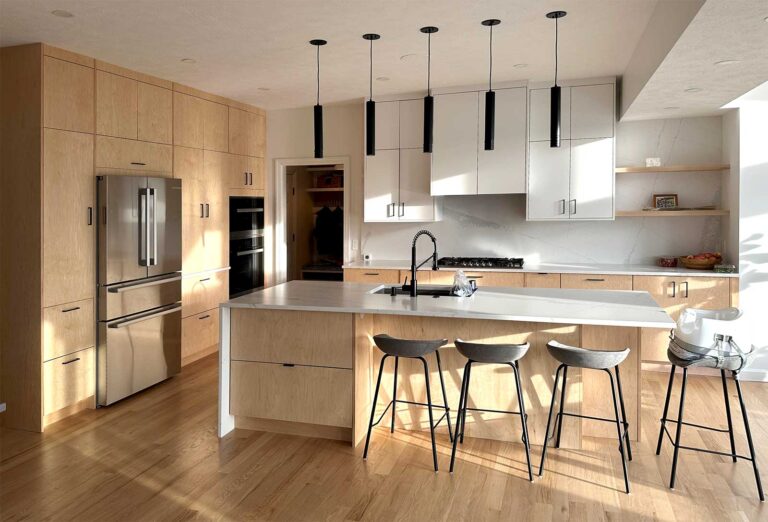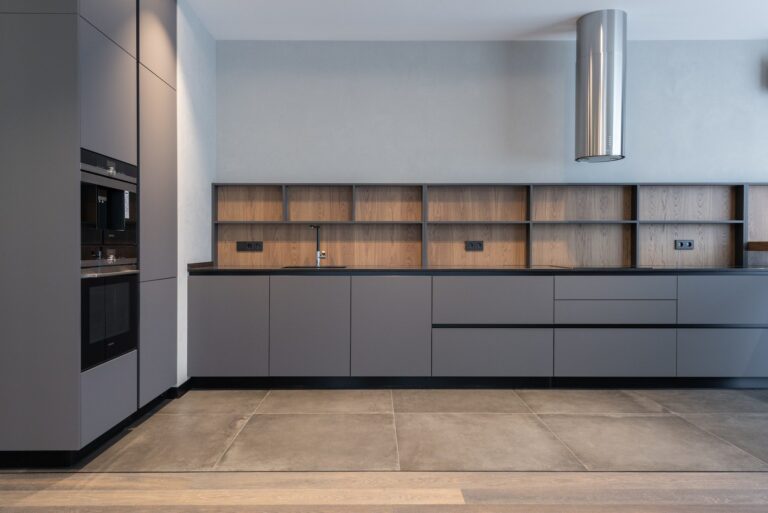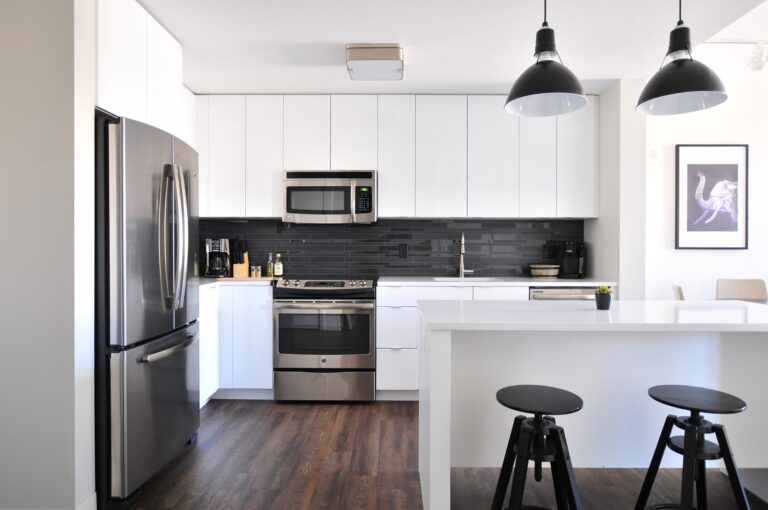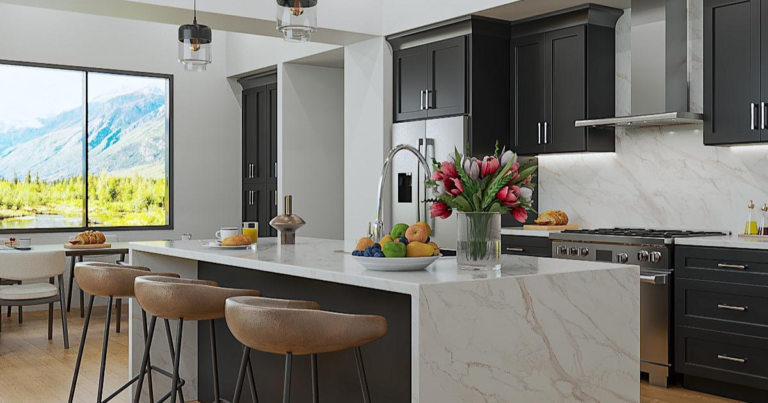

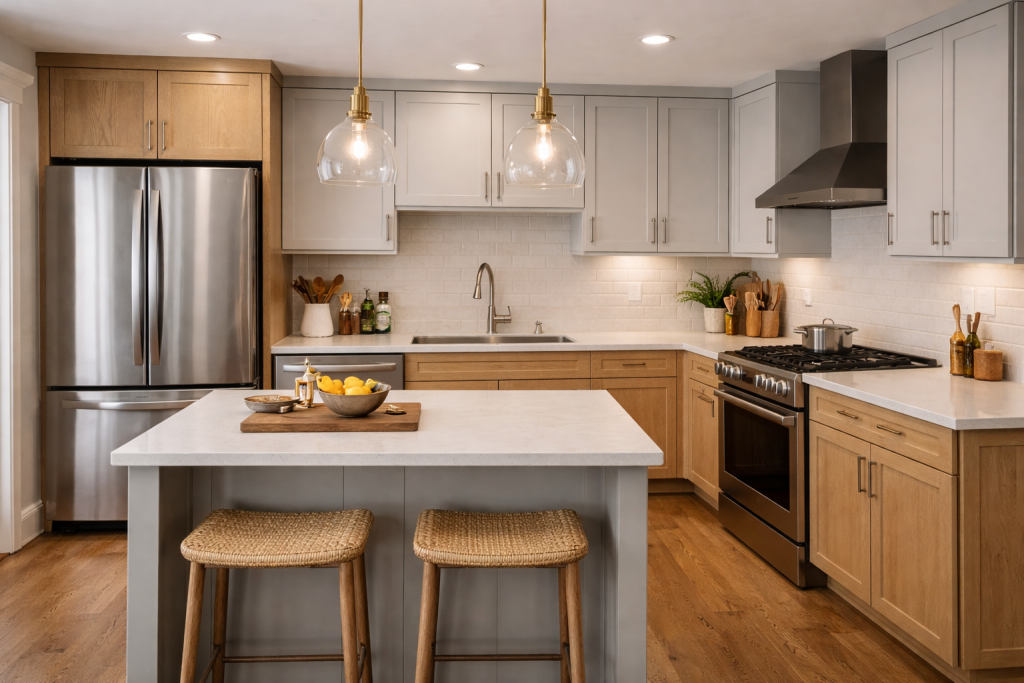
Standard kitchen cabinet dimensions are planning modules, not a substitute for the specification of the cabinet you will order. In many Canadian kitchens, base cabinets finish at about 34.5 inches high before the countertop and use a 24-inch-deep box; conventional wall cabinets are commonly 12 inches deep; and tall pantry cabinets are often offered in 84-, 90- and 96-inch overall heights.
The important detail is what each number measures. A product name may describe the cabinet box, while another specification describes the overall unit with adjustable legs. Doors, handles, finished panels, fillers, countertops and trim can increase the final envelope. Use this guide to build the layout, then verify every selected SKU and appliance before ordering.
Editorial review: August 2026. The ranges below reflect common Canadian planning dimensions and current RTA Depot product examples. Available models can change. The exact product specification, approved kitchen plan and appliance installation instructions control the final order.
Quick Answer: What Are Standard Kitchen Cabinet Dimensions?
A common planning baseline is a 34.5-inch-high, 24-inch-deep base cabinet before the countertop; a 12-inch-deep wall cabinet in a height such as 30, 36 or 42 inches; and a 24-inch-deep pantry cabinet in an overall height such as 84, 90 or 96 inches. Widths vary by cabinet type and commonly increase in 3-inch modules. Always confirm whether a listing includes doors, legs, toe kick, panels or countertop.
| Cabinet Type | Common Planning Size | Current RTA Depot Examples | Verify Before Ordering |
|---|---|---|---|
| Base | About 34.5″ overall height before countertop; 24″ box depth | 9″–42″ widths; 30″ box body with adjustable legs on many models; about 24¾″ deep with door | Box height, leg range, door projection and countertop thickness |
| Wall | Commonly 12″ deep; often 30″, 36″ or 42″ high | 30″ and 36″ standard-depth units plus shorter specialty heights; widths up to 36″ depending on model | Door depth, ceiling line, mounting height and appliance clearances |
| Tall/Pantry | Often 84″, 90″ or 96″ overall height; commonly 24″ deep | 15″, 18″, 24″ and 30″ widths; about 24¾″ deep with doors on current models | Overall height, box height, tip-up clearance, filler and door swing |
| Over-Fridge/Specialty Wall | Shorter height with a depth selected for the appliance layout | Current examples include 12″–24″ heights, 24″ depth and 30″–36″ widths | Refrigerator height, ventilation, door swing, panels and service access |
1. What Does a Cabinet Dimension Actually Measure?
Record three dimensions for every cabinet: its ordering size, its cabinet-box size and its complete installed envelope. Confusing these values is a common reason a cabinet plan fits on paper but conflicts with the room.
| Dimension | What It Describes | What May Be Excluded |
|---|---|---|
| Nominal or ordering size | The module used in a catalogue, cabinet schedule or SKU | Small construction details and model-specific projections |
| Cabinet-box size | The assembled carcass before some external components | Doors, handles, legs, toe kick, countertop, fillers or panels |
| Installed envelope | The total height, width and depth occupied in the room | Nothing relevant: include doors, handles, trim, fillers and required clearance |
2. What Are Standard Base Cabinet Dimensions?
A conventional planning baseline is approximately 34.5 inches (87.6 cm) high before the countertop and 24 inches (61 cm) deep at the cabinet box. After a typical countertop is added, the work surface is often near 36 inches, but the finished height depends on the cabinet system, leg adjustment and countertop specification.
| Measurement | Common/RTA Depot Planning Value | Planning Note |
|---|---|---|
| Overall cabinet height | About 34.5″ / 87.6 cm before countertop | Current RTA Depot examples reach this height with adjustable legs |
| Cabinet-box depth | 24″ / 61 cm | Current flat-panel examples are approximately 24¾″ / 62.9 cm with the door |
| Width | Common modules from 9″ to 42″ / 22.9 to 106.7 cm | Not every cabinet type is offered at every width |
| Finished counter height | Often near 36″ / 91.4 cm | Calculate from actual cabinet height plus the selected countertop |
Select the width by function as well as available wall space. The current RTA Depot base cabinet range shows how available widths differ across full-door, drawer and other base configurations. Sink, cooktop and corner cabinets need their own specification because plumbing, appliance cut-outs, door access and corner footprints can change the usable space.
Do not calculate the counter run from cabinet boxes alone. Include finished end panels, fillers, appliance openings and any side clearance required by the selected hardware or appliance.
3. What Are Standard Wall Cabinet Dimensions?
Conventional wall cabinets are commonly 12 inches (30.5 cm) deep. Full-height upper cabinets are often available in 30-, 36- or 42-inch heights, while widths commonly increase in 3-inch modules. The current RTA Depot wall cabinet box range includes 30- and 36-inch-high standard-depth boxes plus shorter specialty cabinets.
| Measurement | Common Planning Range | Use It To Decide |
|---|---|---|
| Depth | 12″ / 30.5 cm for a conventional upper box | Counter access, storage depth and alignment |
| Height | Often 30″, 36″ or 42″ / 76.2, 91.4 or 106.7 cm | Ceiling relationship and vertical storage |
| Width | Frequently 9″–36″ / 22.9–91.4 cm, model-dependent | Door count, shelf span and alignment with base units |
| Specialty height/depth | Shorter 12″–24″ heights and some 24″-deep models | Over-fridge, above-window or full-depth storage conditions |
Wall-cabinet mounting height is a separate decision from cabinet height. It depends on the finished countertop, backsplash, user needs, ceiling, range hood, microwave and appliance instructions. Do not force one universal counter-to-cabinet gap into every kitchen.
4. What Are Common Pantry Cabinet Dimensions?
Common tall pantry modules are 84, 90 or 96 inches high and approximately 24 inches deep. The current RTA Depot pantry cabinet collection includes 15-, 18-, 24- and 30-inch widths across selected heights. Current flat-panel product specifications list a 24-inch cabinet depth and approximately 24¾ inches with the doors.
| Measurement | Current Planning Options | Critical Fit Check |
|---|---|---|
| Overall height | 84″, 90″ or 96″ / 213.4, 228.6 or 243.8 cm | Finished ceiling, bulkhead, trim and adjustable-leg range |
| Width | 15″, 18″, 24″ or 30″ / 38.1, 45.7, 61 or 76.2 cm | Filler, side panel, handle and adjacent-appliance clearance |
| Depth | 24″ / 61 cm box; about 24¾″ / 62.9 cm with doors on current examples | Aisle, pantry-door swing and alignment with adjacent units |
| Raising envelope | Greater than the cabinet’s vertical height when tipped upright | Ceiling clearance along the complete lifting path |
A pantry should not be chosen from ceiling height alone. An assembled tall box needs additional space while rotating upright, and its doors may need a filler beside a wall or refrigerator. Use the guide to measure before installing a pantry cabinet for the tip-up check and complete opening worksheet.
The cabinet also has to belong in the work plan. Review where to place a pantry cabinet before committing to its width, door handing, filler and adjacent appliance panel.
5. Do Cabinet Styles Change the Dimensions?
The colour or door design normally does not change the nominal module within the same cabinet family, but construction details can change the usable interior and complete installed envelope. Compare products using the same measurement definition.
- Door and drawer fronts: record their thickness and how far they project beyond the box.
- Handles: include projection and conflicts with walls, adjacent handles and appliance doors.
- Finished side panels: add their thickness to a wall-to-wall run or appliance surround.
- Hinge and opening geometry: confirm the space required for the selected door to open fully.
- Interior construction: shelves, drawer slides, dividers and face construction affect usable storage even when exterior widths match.
If a cabinet is sold as a box-only unit, do not assume a separately selected door creates the same final depth or clear opening as a complete cabinet SKU. Verify component compatibility and the assembled specification.
6. How Do Specialty Cabinets and Appliances Affect the Plan?
Appliance labels are not cabinet-opening specifications. A “30-inch” range, refrigerator or wall oven may require a different rough opening, ventilation gap, electrical location or door clearance. Use the installation document for the exact appliance model before approving the cabinet list.
| Area | Do Not Size It From | Use Instead |
|---|---|---|
| Refrigerator surround | Nominal fridge width alone | Overall appliance dimensions, required clearances, hinge swing, panels and over-fridge cabinet |
| Range and hood | The range label or wall-cabinet width by itself | Range and hood manuals, ventilation design and required mounting clearances |
| Dishwasher | A generic opening copied from another model | Exact cut-out, levelling, door and service specifications |
| Sink base | Sink nominal width alone | Sink cut-out, bowl, clips, plumbing and cabinet-interior requirements |
| Corner cabinet | Door width or visible face alone | Full wall footprint, required pull, adjacent drawer/door clearance and corner angle |
7. How Do You Build a Kitchen Run From Standard Cabinet Sizes?
Start with the finished room and fixed openings, not a list of cabinet widths. Deduct the appliance openings, required panels, fillers and clearances from the usable wall length. Fill the remaining run with cabinet modules that support the storage and work zones.
Planning formula
Usable cabinet width = finished wall length − appliance openings − finished panels − fillers − required clearances
- Lock fixed conditions: doors, windows, plumbing, electrical, ventilation and appliance locations.
- Choose the anchors: sink base, range opening, refrigerator surround, corner unit and pantry.
- Add functional modules: drawers, waste pull-out, tray storage and everyday cabinet storage.
- Reserve adjustment space: finished panels, wall fillers, scribe material and hardware clearance.
- Verify the complete run: check every width against the approved cabinet schedule and actual product SKU.
An L-shaped, U-shaped or galley plan uses the same modules differently. Compare the traffic and corner implications in the L-, U- and galley kitchen layout guide. Keep the dimensions article focused on product size; use the layout guide to decide where the modules belong.
8. What Should You Check Before Ordering Cabinets?
A standard-size cabinet still requires a site-specific fit check. Measure the finished room at several points and reconcile it with the cabinet schedule, appliance documents and installation path.
- ✓Measure wall lengths at relevant heights and depths; do not rely on one reading.
- ✓Record ceiling height, bulkheads, trim and the raising path for tall cabinets.
- ✓Map doors, windows, finished floor, outlets, plumbing, vents and other fixed obstructions.
- ✓Confirm appliance model numbers, overall dimensions, required openings and door swings.
- ✓Check floor level, wall plumb, corner squareness and likely filler or scribe conditions.
- ✓Verify every cabinet box, door, leg, panel, filler, handle and trim component on the final order.
The detailed pantry cabinet measuring checklist explains how to record a tall-cabinet opening. Its wall, floor, obstruction and clearance checks also apply to other cabinet runs.
If measurements change across the room, diagnose the surface before altering the cabinet list. The guide to installing cabinets on uneven floors and walls explains how level references, shims and scribed fillers handle appropriate site variation without twisting the cabinets.
9. What Comes After Cabinet Sizing?
Move from dimensions to preparation only after the cabinet schedule and room checks agree. Use the specialist guide for the next task instead of treating a size chart as installation instructions.
| Next Task | Use This Guide | What It Owns |
|---|---|---|
| Plan the complete sequence | Kitchen cabinet installation in Canada | Room verification through final fit |
| Build the cabinet boxes | How to assemble RTA cabinets | Parts, panel orientation, joining and squaring |
| Diagnose a box that will not assemble correctly | RTA cabinet assembly problems and fixes | Out-of-square boxes, panels, connectors, drawers and doors |
| Prepare a pantry installation | Pantry cabinet installation tools | Measuring, leveling, fastening and safety equipment |
| Install a tall pantry | Pantry cabinet installation guide | Positioning, leveling, fastening, fillers and final adjustment |
| Run a prevention check | RTA cabinet installation mistakes | Measurement, leveling, fastening, fillers and adjustment errors |
Need Help Confirming Cabinet Sizes?
RTA Cabinet Depot can compare your wall measurements, appliance list and storage priorities with available base, wall and pantry modules before you order. Bring the finished-room measurements and exact appliance model numbers so the proposed cabinet schedule can be checked as one complete run.
10. Standard Kitchen Cabinet Dimensions FAQ
What is the standard height of a base kitchen cabinet?
A common overall height is about 34.5 inches before the countertop. In cabinet systems with adjustable legs, the box itself may be shorter. Verify the box height, leg range and countertop thickness rather than assuming the product title is the finished height.
What is the standard depth of a base cabinet?
A conventional base-cabinet box is commonly 24 inches deep. Doors and handles increase the installed projection. Current RTA Depot flat-panel examples list approximately 24¾ inches with the door.
What is the standard depth of a wall cabinet?
A conventional wall-cabinet box is commonly 12 inches deep. Specialty units, including some over-fridge cabinets, may be 24 inches deep, so check the selected SKU and the surrounding head, door and appliance clearances.
What are common wall cabinet heights?
Thirty, 36 and 42 inches are common full-height upper-cabinet options across modular systems. Shorter cabinets are used above refrigerators, windows, microwaves and other special conditions. The available heights depend on the product family.
What are common pantry cabinet sizes?
Common overall heights are 84, 90 and 96 inches, with a typical 24-inch box depth. Current RTA Depot examples include 15-, 18-, 24- and 30-inch widths. Confirm the complete height with legs, door projection, filler and raising clearance.
Do cabinet dimensions include doors and countertops?
Not always. A depth may describe only the cabinet box, while a height may describe the overall unit with legs but without a countertop. Read the product specification for box, door, leg, panel and countertop dimensions separately.
How much filler should be left beside a wall or appliance?
There is no universal filler width. It depends on the wall condition, hinge, handle, desired door opening, adjacent appliance, finished panel and installation adjustment. The approved layout and exact products should determine the filler.
Can standard cabinets fit an uneven room?
Often, yes. Standard modules can be leveled and aligned while fillers, panels, approved adjustable legs or stable shims accommodate appropriate site variation. The cabinets should remain level, plumb, square and supported rather than following an uneven floor or being pulled against a bowed wall.