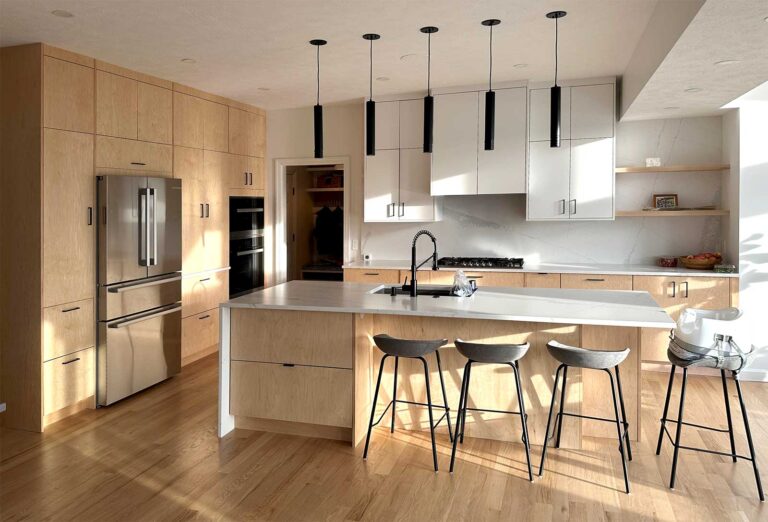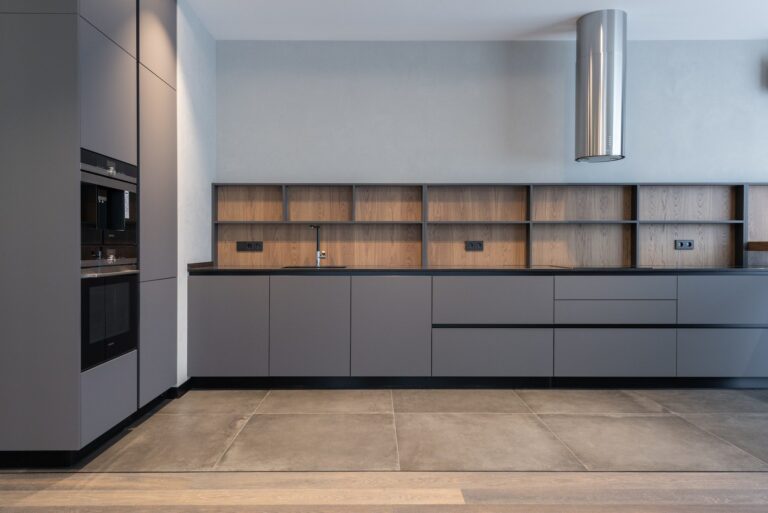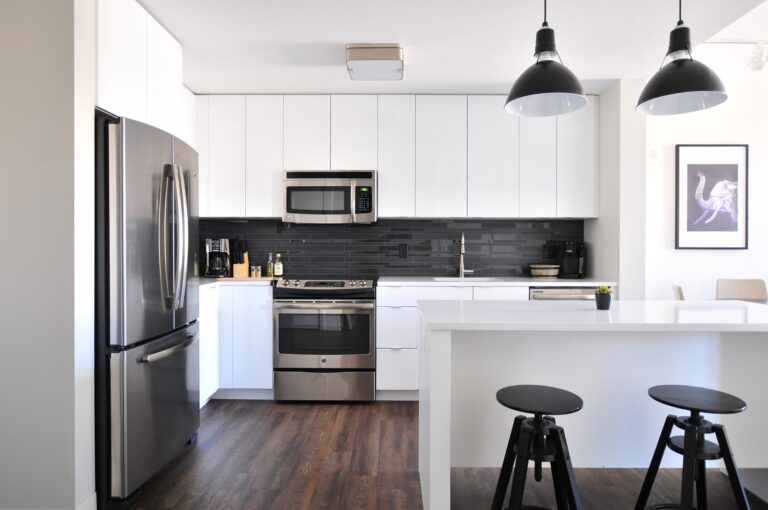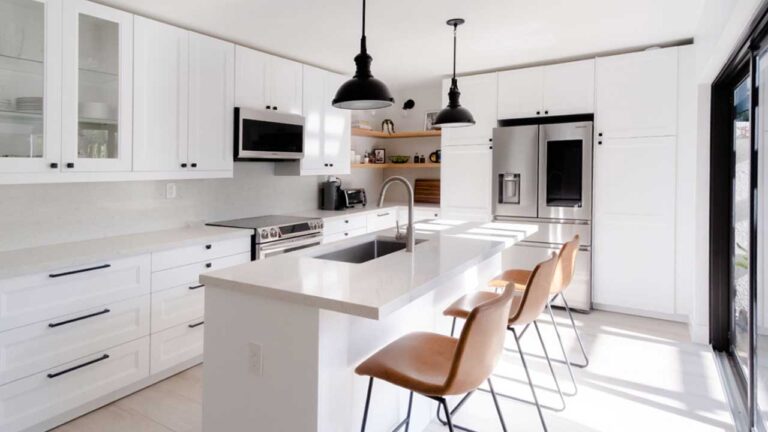

Installing an RTA pantry cabinet requires more care than placing a standard base cabinet. A tall cabinet must fit the opening, stand plumb, remain square and connect securely to suitable wall framing or an approved support system. Filler space, appliance clearance and door swing must also be confirmed before final fastening.
This Canadian pantry cabinet installation guide covers the complete sequence from pre-installation checks to final door adjustment. It focuses on the installation process; detailed measuring, sizing, placement, tool and troubleshooting guidance is linked to the relevant supporting guide.
Editorial review: July 2026. Product construction and fastening requirements vary. Follow the instructions supplied with your cabinet and use a qualified installer when the wall structure, required fastener or safe handling method is uncertain.
Quick Answer: How Do You Install an RTA Pantry Cabinet?
To install an RTA pantry cabinet, verify the opening and door clearance, assemble the cabinet square, mark suitable wall attachment points, move the cabinet into position, level it front-to-back and side-to-side, fasten it without distorting the box, connect adjacent panels or cabinets, then install shelves, fillers, toe kicks and doors.
1. What Should You Check Before Installing a Pantry Cabinet?
Confirm the room, cabinet and layout before opening or assembling the cabinet. The cabinet width alone does not prove that the installation will work. Ceiling height, standing-up clearance, floor level, wall condition, trim, fillers, appliance projections and door swing can all change the usable opening.
- Opening: confirm wall width, ceiling height and any bulkhead, crown or finished-floor restriction.
- Cabinet: verify the ordered model, finished dimensions, door handing and all supplied parts.
- Layout: check the pantry face line against adjacent cabinets, refrigerator panels and countertops.
- Clearance: test pantry doors, appliance doors, handles, walkways and nearby walls for conflicts.
- Support: identify the wall construction and the cabinet’s approved fastening area before drilling.
- Services: check for plumbing, wiring or other concealed services in the proposed drilling area.
Use the dedicated pantry cabinet pre-installation measuring checklist for room measurements. For nominal cabinet sizes and appliance openings, see the standard kitchen cabinet dimensions guide. Always verify the actual product specification before ordering or cutting fillers.
2. Which Tools Are Needed for Pantry Cabinet Installation?
Most pantry installations require tools for measuring, squaring, leveling, clamping and fastening. The exact drill bits, screws, anchors and cutting tools depend on the cabinet and wall construction; they should not be selected from a generic list alone.
| Task | Typical tools | Check before use |
|---|---|---|
| Measure and mark | Tape measure, pencil, straightedge | Finished surfaces and actual opening |
| Square and level | Carpenter’s square, suitable level, shims | Box diagonals and floor high point |
| Locate support | Stud finder plus an appropriate verification method | Wall type and concealed services |
| Join and fasten | Clamps, drill/driver, manufacturer-approved fasteners | Fastening rail, screw length and wall substrate |
See the complete pantry cabinet installation tool checklist before starting. Wear suitable eye and hand protection, keep the work area clear and get help moving a tall cabinet.
3. How Do You Install an RTA Pantry Cabinet Step by Step?
The correct sequence is plan, inspect, assemble, position, level, fasten, connect, finish and verify. Do not use final fastening to pull a crooked cabinet into position. The box should be square and supported correctly before it is secured.
Step 1: Confirm the Pantry Position and Finished Face Line
Mark the planned pantry location and compare it with the approved kitchen layout. Confirm the front edge relative to adjacent cabinets, panels and appliances. Recheck door swing and filler allowances; changing these after fastening usually creates avoidable rework.
Step 2: Unpack and Inspect Every Component
Compare panels, shelves, doors and hardware with the packing list. Inspect finished faces, corners, grooves and pre-drilled holes before assembly. Stop if a structural panel or required fastener is missing or damaged.
Step 3: Assemble and Square the Cabinet Box
Assemble the cabinet on a clean, flat and protected surface using the product instructions. Before fixing the back or completing the assembly, confirm the box is square using a carpenter’s square and matching diagonal measurements. A twisted box will make later door adjustment unreliable.
For the complete box-building sequence, use the step-by-step RTA cabinet assembly guide. If the box will not square up or hardware does not engage correctly, consult RTA cabinet assembly problems and fixes before proceeding.
Step 4: Mark Wall Support and Check the Drilling Area
Identify suitable attachment points and mark them where they can be transferred to the cabinet’s approved fastening rail or mounting area. A stud finder is a locating aid, not proof that drilling is safe. Verify the wall construction and check for concealed electrical, plumbing or other services.
Step 5: Move the Pantry Cabinet Into Position
Use two or more people, or suitable lifting equipment, for a cabinet that cannot be handled safely by one person. Keep the unit supported, protect the finished floor and avoid using doors, shelves or loose panels as lifting points.

Step 6: Level, Plumb and Align the Cabinet
Check side-to-side level, front-to-back level and vertical plumb. Add shims or adjust the cabinet’s approved feet or base system at proper support points. Recheck the face line and door opening after every adjustment; a small movement at the base becomes more visible at the top of a tall cabinet.
Step 7: Fasten the Pantry Cabinet Securely
With the cabinet supported, level and plumb, fasten through the cabinet’s designated structural rail or mounting location using hardware suitable for both the cabinet system and wall construction. Do not rely on drywall alone, over-tighten fasteners or use screws to force the box against a bowed wall.
Step 8: Connect Adjacent Cabinets, Panels and Fillers
Clamp adjacent cabinet faces or approved connection points flush before joining them. Fit fillers and finished panels without pulling the pantry cabinet out of plumb. Maintain the clearances required for doors, handles and nearby appliances.
Step 9: Install Shelves and Doors, Then Make Final Adjustments
Install shelves and doors only after the cabinet is secure. Adjust hinge height, side position and depth according to the supplied hardware instructions. Confirm even reveals, smooth door movement and adequate clearance before adding the toe kick, trim or stored items.
4. How Do You Install a Pantry Cabinet on an Uneven Floor or Wall?
Establish a level, fully supported base instead of making the cabinet follow the floor. Use the cabinet manufacturer’s approved adjustment method and place shims only where the cabinet remains properly supported. A bowed wall should be accommodated at fastening points or with a scribed filler—not corrected by forcing the cabinet box against it.
Uneven surfaces require more diagnosis than this overview can provide. Follow the dedicated guide to installing cabinets on uneven floors and walls before cutting fillers or fastening the pantry cabinet.
5. Pantry Cabinet Final Inspection Checklist
Inspect the cabinet before installing trim or loading shelves. Final hinge adjustment cannot compensate for a cabinet that is unsupported, twisted or out of plumb.
- ✓The cabinet is level side-to-side and front-to-back.
- ✓Both sides are plumb and the box remains square.
- ✓The base is supported without unstable or exposed shims.
- ✓Fasteners pass through approved cabinet locations into suitable support.
- ✓Adjacent cabinets and panels remain aligned after fastening.
- ✓Doors open fully without hitting walls, handles or appliances.
- ✓Shelves, hinges, fillers, finished panels and toe kicks are secure.
6. Which Pantry Cabinet Installation Mistakes Should You Avoid?
The most damaging mistakes occur before final fastening: ordering from nominal measurements, overlooking standing-up clearance, skipping filler space, leveling only one face, fastening into unsuitable material, pulling the box against a bowed wall and adjusting doors before the cabinet is secure.
| Mistake | Likely result | Correction |
|---|---|---|
| No real-site measurement | Cabinet, filler or door conflict | Recheck the finished opening and full door swing |
| Fastening before alignment | Twisted box and uneven door gaps | Support, level, plumb and clamp first |
| Using screws to pull in the cabinet | Distorted cabinet or damaged panel | Shim or scribe at the correct location |
| Adjusting doors too early | Gaps change after leveling and fastening | Make hinge adjustments last |
For the broader checklist, review seven RTA cabinet installation mistakes to avoid.
7. Should You Install a Pantry Cabinet Yourself?
DIY installation is reasonable only when the installer can safely handle the cabinet and verify every support and clearance condition. A straightforward project may suit an experienced DIYer; a heavy unit, uncertain wall, uneven room, complex panel arrangement or appliance conflict calls for professional help.
| DIY may be suitable when | Use a professional when |
|---|---|
|
|
8. Planning an RTA Pantry Cabinet Project in Canada?
RTA Cabinet Depot supplies ready-to-assemble cabinets for Canadian kitchen projects. Before ordering, confirm the cabinet model, finished dimensions, fillers, door clearance and relationship to nearby cabinets and appliances.
Get Pantry Cabinet Sizing and Layout Help
Request help checking pantry size, filler space and the full kitchen layout before placing an order.
Call +1 888 973 5636 or explore RTA kitchen cabinets.
9. Pantry Cabinet Installation FAQ
Do pantry cabinets need to be fastened to the wall?
A tall pantry cabinet should be secured using the attachment method specified for the cabinet and the actual wall construction. Drywall alone should not be treated as structural support. If suitable framing or an approved support system cannot be confirmed, stop and consult a qualified installer.
Should a pantry cabinet be installed before or after base cabinets?
The sequence depends on the kitchen plan and cabinet system. Tall units are commonly positioned as reference points for adjacent runs, but they should not be finally fastened until their face line, level, panels, fillers and appliance clearances have been checked against the complete layout.
How much filler is needed beside a pantry cabinet?
There is no universal filler width. The required amount depends on the door and handle projection, hinge movement, wall condition, nearby trim and the cabinet manufacturer’s layout rules. Calculate the filler from the actual site and product details rather than using a generic allowance.
Why are pantry cabinet doors uneven after installation?
Uneven gaps usually indicate that the cabinet is out of level, out of plumb, twisted during fastening or not fully supported. Check the cabinet box first. Adjust the hinges only after the cabinet is square, secure and aligned with adjacent units.
Can one person install an RTA pantry cabinet?
A tall pantry cabinet can be heavy and difficult to control, especially after assembly. Use enough people or appropriate handling equipment to keep the cabinet stable and protect nearby finishes. Do not attempt a one-person installation when the unit cannot be lifted and held safely.
What should be checked before loading the cabinet?
Confirm that the cabinet is level, plumb, square, fully supported and securely fastened. Test all doors and shelves, inspect connection points and complete trim work before adding stored items. Recheck the installation if the cabinet moves or door gaps change under normal operation.

Sang Vi is a Senior Interior Designer and founder of Wedesign Interior Lab, as well as CEO of the Wedesign Interior Lab, MOC Concepts (Kitchen Cabinets), and Sang Vi Woodworking Manufacturer group. Since 2019, Sang has led an NKBA-certified team specializing in kitchen planning and cabinetry, completing dozens of projects each year across Toronto and other regions in Canada. With deep, hands-on experience in both custom millwork and ready-to-assemble (RTA) kitchen cabinets, Sang focuses on creating designs that are functional, durable, and easy to install. On this RTA platform, Sang shares practical, real-world insights to help homeowners choose, plan, and optimize their kitchen cabinet systems with confidence